Product Description
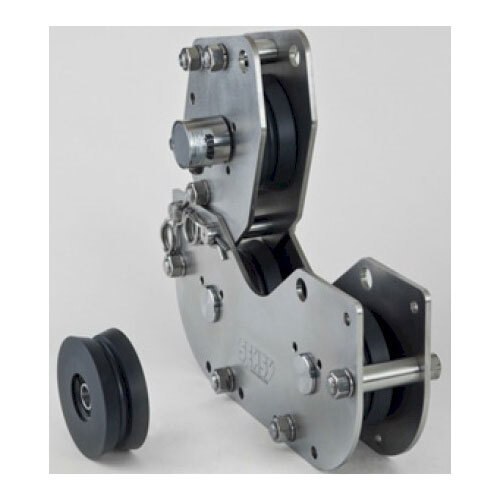
A running line tension meter is a device used to measure the tension of a running line, which is a type of line that moves through a pulley or sheave system, such as those used in industrial or marine applications.
The running line tension meter typically consists of a sensor or load cell that is attached to the line, and a display unit that shows the tension measurement. The sensor measures the force exerted on the line as it moves through the system, and converts it into an electrical signal which is then displayed as a tension reading on the display unit.
Running line tension meters are commonly used in applications such as ship mooring, offshore oil and gas drilling, and industrial lifting operations, where it is important to monitor and control the tension on the line to ensure safe and efficient operations.
In ship mooring, for example, a running line tension meter can be used to ensure that the tension on the mooring lines is within safe limits, preventing the ship from drifting away from the dock or being damaged by excessive tension. In offshore drilling, running line tension meters can be used to monitor the tension on the drilling lines to ensure that the drill bit is properly supported and drilling operations are conducted safely.
Overall, running line tension meters are an important tool in many industrial and marine applications, helping to ensure safe and efficient operations by monitoring and controlling the tension on running lines.
High Precision, User-Friendly DesignDelivering accuracy of 1% of full scale with 0.01 kg resolution, the Line Tension Meter is tailored for industrial, laboratory, and field usage. Its large backlit LCD and intuitive analog scale offer clear readings, while the shock-resistant casing ensures resilience even in tough environments. The devices portable, lightweight design (approx. 1.5 kg) and dual power source (2 x AAA batteries) allow for ease of operation and maintenance anywhere tension measurement is required.
Robust Functionality for Diverse ApplicationsWhether youre measuring cable, rope, or wire tension, this meter is equipped with a high-sensitivity mechanical load cell capable of handling diameters as small as 0.05 mm. It provides both manual and automatic zero adjustment and features data hold, overload buzzer, and auto power-off to extend battery life. Its IP54 protection makes it ideal for dusty or damp locations, supporting use in manufacturing, installation, and quality control tasks.
FAQs of Line Tension Meter:
Q: How do I use the Line Tension Meter for measuring cable or wire tension?
A: To measure tension, simply clamp or hand-hold the meter onto the line, cable, or wire. Ensure it is properly seated, turn on the device, and view the tension reading on the large backlit LCD display. Use the manual or automatic zero adjust as needed to ensure measurement accuracy.
Q: What are the benefits of the large backlit LCD and data hold function?
A: The large backlit LCD provides excellent visibility in all lighting conditions, making it easy to read measurements. The data hold function allows you to freeze the current reading on the display, which is helpful when working in hard-to-access areas or recording measurements for documentation.
Q: When should I calibrate or re-calibrate the Line Tension Meter?
A: The meter is factory calibrated for immediate use. However, if your application demands stringent accuracy or after frequent use, user re-calibration is possible and recommended periodically to maintain optimal performance.
Q: Where can I store or use the Line Tension Meter?
A: Designed to operate between 0C and 50C, and be stored within -10C to 60C, this portable meter is ideal for on-site, laboratory, or industrial environments. Its IP54 rating protects it against dust and splashing water, suitable for various field conditions in India and beyond.
Q: What process does the device use to provide accurate tension readings?
A: It uses a mechanical force input via a high-sensitivity mechanical load cell sensor. The sensor instantly transmits force changes to the analog scale display, with a real-time sampling rate of 10 readings per second, ensuring immediate and precise tension measurement.
Q: Is the Line Tension Meter suitable for small diameter samples?
A: Yes, the meter can accurately measure wires or threads as thin as 0.05 mm, making it suitable for a wide range of applications in industries like electrical, textile, or cable manufacturing.
Q: What are the main benefits of using this Line Tension Meter in industrial or laboratory settings?
A: Key benefits include high measurement accuracy, robust and dust/splash-proof design, instant response time, and ease of use. Its shock-resistant housing, manual and automatic zero adjust, audible overload alarm, and intuitive interface allow for reliable tension monitoring and enhanced safety in diverse environments.





 Send Email

 Send Inquiry


