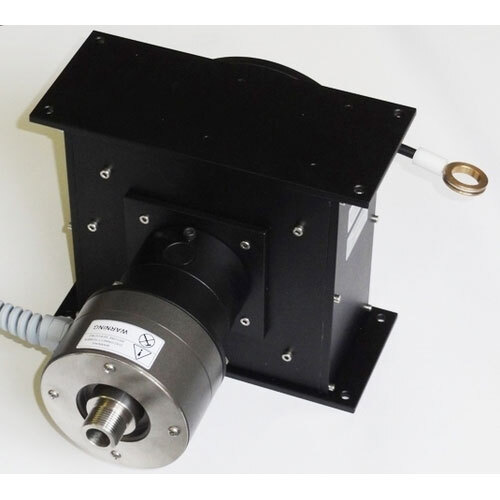
Product Description
|
Technical Data
|
|
|
Operating temp:
|
- 40 ...+ 60 degrees C
|
|
|
|
-40 ...+ 140 degrees F
|
|
|
Certification:
|
ATEX, IECEx, CSA
|
|
|
Weight:
|
15 lbs (6.8 kg)
|
|
|
Protection:
|
IP 54 (structure)
|
|
|
Material Structure:
|
Coated Aluminum
|
|
|
Tension Springs:
|
Dual springs
|
|
|
Mechanism:
|
Aluminum
|
|
|
Material Pulleys:
|
Aluminum
|
|
|
Material Cable:
|
Stainless Steel 2.2mm
|
|
|
Material Encoder:
|
Depends on Model
|
|
|
Tension on Cable:
|
Between 15 and 20N
|
|
|
Max Reel Out Accel:
|
25m/s2
|
|
|
Max Reel In Accel:
|
10m/s2
|
|
|
Cable Break Load:
|
3,622 N
|
|
|
Max Static Torque:
|
35N
|
|
|
|
|
Total Error:
|
+/- 2.2mm
|
|
Part Number
- EM9FA4 / 10CD - 10m cable
- EM9FA4 / 12CD - 12m cable
- EM9FA4 / 15CD - 15m cable
- EM9FA4 / 18CD - 18m cable
After the 10CD, 12CD, 15CD or 18CD add first 4 digits ofencoder to be used so we can make the adaptor flange
Output Options from Encoder
- Any standard drawworks (NAMFPX) series encoders
- Incremental 5...24V
- Incremental NAMUR
- Tachometer
Multi-turn solid shaft encoders
- Absolute Parallel
- Absolute ProfiBus
- Absolute Device Net
Superior Performance in Dynamic Sea ConditionsEngineered to maintain precision in unpredictable marine environments, the Heave Compensator offers high sensitivity and millimeter-scale compensation. Its integrated sensor options and rapid response time (<150 ms) deliver real-time vertical displacement control, ensuring stability and safety during offshore lifting, subsea operations, and drilling.
Easy Integration and Low MaintenanceDesigned for straightforward compatibility with offshore control systems including PLC and HMI interfaces, the modular construction of the Heave Compensator streamlines servicing and parts replacement. It accommodates both flange and frame-mounted installations with customizable cable lengths and wireless monitoring options.
Customizable for Diverse Offshore ApplicationsWith variable stroke, custom anchorage points, and optional load/displacement sensors, this system adapts to varying operational and environmental needs. Built to meet ISO 13628-7 and API RP 2SK standards, it is trusted across oil and gas rigs, marine cranes, and winch compensation applications worldwide.
FAQs of Heave Compensator:
Q: How does the Heave Compensator improve safety and stability on offshore platforms?
A: By absorbing and compensating for vertical displacement due to wave motion, the Heave Compensator minimizes load oscillation and impact forces. This leads to safer lifting, precise positioning, and enhanced protection for personnel and equipment during dynamic sea conditions.
Q: What process is involved in integrating the Heave Compensator with existing offshore systems?
A: Integration typically requires connection to platform control interfaces like PLC, HMI, or remote monitoring systems. The compensators adaptable design and standard signal options (analog/digital) ensure compatibility with most control architectures. Installation can be flange or frame-mounted, with customizable cable lengths and wireless monitoring options available.
Q: Where is the Heave Compensator typically used, and who benefits from its application?
A: It is widely employed in offshore drilling rigs, marine cranes, subsea operations, and winch compensation. Operators, rig managers, and vessel crews benefit from minimized load movement, improved safety, and enhanced operational efficiency during heavy lifts and marine transfer tasks.
Q: What maintenance advantages does the modular design of the Heave Compensator provide?
A: The modular architecture allows for quick access to service points, efficient component replacement, and reduced downtime during routine checks. This design simplifies on-site maintenance and supports long-term reliability in harsh marine environments.
Q: When is it recommended to select variable stroke or custom anchorage for a compensator system?
A: Variable stroke and bespoke anchorage options should be considered when lifting requirements or deck configurations differ from standard applications. Customization ensures the compensator delivers optimal displacement accuracy and matches specific project needs or equipment layouts.
Q: What operating conditions and environmental protections are provided by the system?
A: With an IP66 or higher rating for exposed electrical/electronic components, the compensator operates reliably from -20C to +55C. The marine-grade anti-corrosive coating and rugged alloy construction protect against saltwater, humidity, and mechanical wear.
Q: How do integrated sensors contribute to performance and ease of monitoring?
A: Optional load and displacement sensors provide real-time feedback and precise control, enhancing measurement accuracy up to 2%. These sensors enable PLC or remote monitoring, streamlined operations, and better predictive maintenance, with wireless options available for flexible data access.





 Send Email

 Send Inquiry


