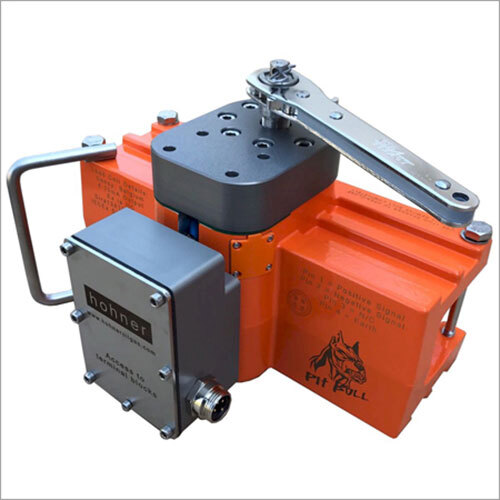
Product Description
|
Technical Data
|
|
Operating temp:
|
- 40 ...+ 60 degrees C
|
|
|
-40 ...+ 140 degrees F
|
|
Load Cell Certification:
|
ATEX, CSA and IECEx
|
|
Weight:
|
22 lbs (10 kg)
|
|
Protection:
|
IP 66 / X7 M
|
|
Material Load Cell:
|
Stainless Steel
|
|
Material Chassis:
|
Aluminum
|
|
Material Clamp:
|
Stainless Steel
|
|
Output Tolerance:
|
0.25% of full scale
|
|
Calibration Error:
|
Under 5%
|
|
Temp Effects:
|
Full shift 0.035%/10C
|
Connection Options
MS6, MS7, MS10 (available with junction box as well)
- + Loop Pin A
- - Loop Pin D
Installation
- Installed on the deadline side
- Output is linearly proportional to tension on deadline
- For 0.75to 2.5cable diameters
- Output Limits (always linear)
- At min weight, the output is 4mA (point set by user)
- At max weight, the output is 20mA (point set be user)
Advanced Voltage DetectionEngineered for precise live-dead wire checking, the sensor uses high-sensitivity electrostatic technology to detect voltage presence or absence from a 210 cm distance. Its digital signal provides clear and immediate status, enhancing safety for maintenance staff during hazardous operations on overhead lines.
Rugged and High-Visibility DesignManufactured with a durable polycarbonate body and fitted with an aluminium clamp, the sensor is both lightweight and weatherproof, ensuring reliable performance across tough environments. The bright yellow and black color scheme aids visibility in field applications, while IP54 compliance protects against dust and splashing water.
FAQs of Dead Line Sensor:
Q: How does the Dead Line Sensor with Buzzer and Flashing LED detect voltage presence or absence?
A: The sensor uses electrostatic/non-contact voltage detection, identifying live or dead electrical conductors without direct connection. For dead lines, the LED remains continuously ON, while for live wires, the LED switches OFF and a buzzer alarm sounds for clear indication.
Q: What is the process for using this sensor during electrical maintenance?
A: To use the sensor, maintenance personnel clamp it onto the conductor. The device instantly analyzes voltage status: if the line is dead, the LED stays ON; if live, the LED turns OFF and the alarm buzzes. No cable or interface is necessary, enabling straightforward, standalone operation.
Q: When should electrical maintenance teams utilize this sensor?
A: Teams should use this sensor prior to handling or servicing overhead electrical lines, particularly during shutdowns, repairs, or routine safety checks. Its high-resolution detection ensures lines are confirmed dead before work begins, minimizing risk of electric shock.
Q: Where is this sensor most effectively deployed?
A: This sensor is designed for use on overhead power lines up to 33kV. Its clamp-type mounting and weatherproof construction make it suitable for outdoor electrical substations, pole-mounted installations, and utility maintenance sites across India.
Q: What are the key benefits of using this Dead Line Sensor?
A: Key benefits include fast and accurate voltage detection with 99.5% reliability, high visibility, rugged build quality, minimal power consumption, and compliance with Indian safety standards. Battery backup (optional) ensures the device remains operational during extended field use.
Q: How does battery backup enhance the sensors operational reliability?
A: Optional battery backup allows the dead line sensor to function even during power outages, offering uninterrupted voltage indication and alarm capability when working in remote or emergency conditions.






 Send Email

 Send Inquiry


